Thích Minh Tuệ: The Dharma Unadorned
A life of simplicity and disciplined devotion to the Dharma.

January 29, 2026
Thích Minh Tuệ* is a Vietnamese Buddhist practitioner who has lived for several years as a wandering renunciant in Vietnam and more recently in other parts of Asia. Traveling primarily on foot, he relies on a life of simplicity and minimal possessions. His practice is centered on long walking pilgrimages and elements associated with dhūtaguṇas—ascetic practices described in the early Buddhist tradition—emphasizing contentment with little, steadfastness, mindfulness, and silence.
Although widely known through public encounters along his journeys, he lives and practices quietly, independent of monasteries or formal institutions, orienting his life toward direct practice rather than public roles. He is not affiliated with any religious institution and does not speak from an official or representative position.
Accordingly, this interview with Thích Minh Tuệ focuses not on biography or interpretation, but on lived practice: intention, attention, silence, and letting go. Readers are invited to receive his words in the same spirit in which they were offered—plainly, without embellishment, and oriented toward practice rather than personality.
BDG: What intention guides your way of practice?
Thích Minh Tuệ: I am very fortunate to have read Buddhist scriptures, and from that I have developed faith. Looking back on my life, I realize that thanks to the Buddhist teachings, my life has been less troubled. I am now increasingly confident and committed to learning from the Buddhadharma.
BDG: Which practices are essential for you each day?
Thích Minh Tuệ: The main practice is to tame our mind, to subdue desires and the three poisons, greed, anger, and delusion through a virtuous life. In this way, we can purify our minds.
BDG: While walking, where do you rest your attention?
Thích Minh Tuệ: I chose walking because this provides an opportunity to practice the Dharma without reliance on external factors. When I walk, I have no expectation of help from anyone, and I don’t need to depend on anyone else. I can practice by myself without disturbing anyone. Walking is very simple and conducive to Dharma practice.
Walking in the forest is very convenient for those without money because there’s no need to build paths or use vehicles; it’s a natural gift for practicing meditation and improving health.
BDG: How does silence support your practice?
Thích Minh Tuệ: Silence and quietude are very conducive for cultivating wisdom.
BDG: When possessions fall away to nearly zero, what remains?
Thích Minh Tuệ: When we remove our attachment to possessions, this offers us a chance to liberate our minds without suffering or afflictions, to find real happiness.
Letting go of everything leads to the complete eradication of afflictions and defilements in the mind, and there is no longer any attachment; it leads to peace, wisdom, liberation, and finally nirvana.
But we have to be careful to recognize whether we’ve really abandoned our attachments. For example, perhaps we might give up our money, but ask a relative to look after it for us. In such cases this indicates that we haven’t really surrendered our attachments.
By giving up one’s job one can be totally free from any kind of control, obligation, or duty. If we give up our possessions and money, we don’t need to waste mental energy worrying about thieves or anyone who might try to take them away from us.
BDG: If someone reading this feels called to practice more deeply, what is one thing they could begin with?
Thích Minh Tuệ: For one who wishes to take their practice deeper and further, with more diligence, their first priority should be to approach the Buddha’s teachings and the sutras. Studying the Buddha’s teachings directly will provide a very good foundation, preparation, and orientation to go further.
By having a good knowledge of the Buddha’s teachings, on the way to becoming totally enlightened—a buddha, the practitioner can stabilize their devotion and trust on the path. Trust, devotion, and belief are the most important qualities for a practitioner.
BDG: What kind of clinging seems to cause the most suffering for lay practitioners today?
Thích Minh Tuệ: First lust and attachment. These are the main causes of suffering. Whoever is able to free themselves of lust and attachments can be totally happy.
Attached love breeds sorrowAttached love breeds fear; whoever breaks free from conditional/attached lovewill be free from sorrow and fear. (The Dhammapada)
BDG: What brings joy on the path?
Thích Minh Tuệ: Detaching oneself from desires and attachments leads to a life of purity and virtue, free from the influences of lust and greed. Overcoming greed brings joy. If we cultivate our discipline, meditative concentration, and wisdom, these three together will automatically bring joy on the path.
BDG: What supports devotion?
Thích Minh Tuệ: Trust in the Four Noble Truths. Through devotion we can understand suffering, the causes of suffering, nirvana, and the conditions for attaining nirvana. With devotion, we can understand these causes and conditions deeply, which of course is helpful for our path. As such, I’m so happy to practice as a monastic, as the Buddha taught.
BDG: What weakens practice?
Thích Minh Tuệ: Once again we return to the three poisons, which always serve to undermine our practice. Another factor is our karma, and the circumstances of our birth. We can improve our karma by abiding by the precepts and leading a life of purity and virtue. Even laypeople can practice the Dharma and improve their karma by adhering to the five basic precepts or eight precepts. By keeping these vows we can purify our karma.
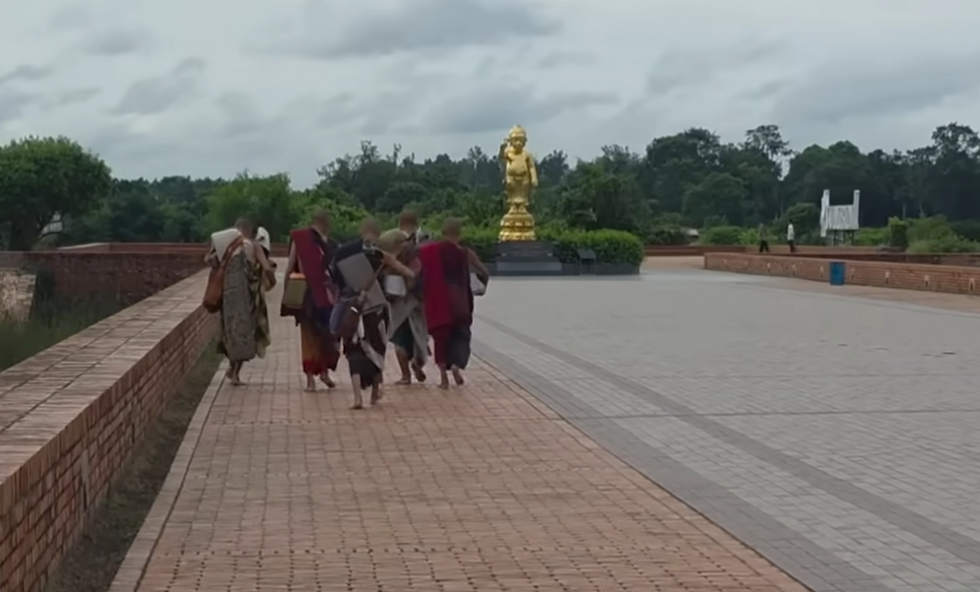
BDG: What does it mean to you personally to practice in Lumbini, where the Buddha was born?
Thích Minh Tuệ: Actually, here or anywhere else in the world, if one can practice and follow the Buddhadharma sincerely, we can progress along the path to enlightenment. It makes no difference.
BDG: Is there any other reflection you’d like to share with our readers?
Thích Minh Tuệ: All people can benefit from learning the Buddha’s teachings and observing the five basic precepts. By doing so, anyone can have a peaceful life. If more people do so, we can have a peaceful world. This is the best path to world peace.
BDG: Thank you venerable for sharing so much of your time with us today.
With gratitude to Ani Khonchog Chodron for her interpretation and patience.
* “Thích” is a prefix used by Vietnamese monastics to signify someone following the path of the Buddha, here included as part of Thích Minh Tuệ’s Dharma name as a mark of respect.
____
See more
Related features from BDG
Thich Minh Tue – A Living Dharma Under Threat: Will India Uphold the Buddha’s Legacy?Thich Minh Tue: A Therapist for a Wounded Society
Related news reports from BDG
Vietnamese Ascetic Thich Minh Tue Adjusts Pilgrimage Route Amid ChallengesVietnamese Ascetic Thich Minh Tue Faces Challenges on Pilgrimage to IndiaRenowned Vietnamese Buddhist Ascetic Thich Minh Tue Embarks on Pilgrimage to IndiaThich Minh Tue, Buddhist Ascetic in Vietnam, Ends Travels after Follower’s DeathThich Minh Tue, Wandering Buddhist Ascetic in Vietnam, Gains a Following
____
Wishing the monks strength and steadfastness on the path of practice.
Wishing all who revere the path peace and well-being.
Respectfully,
Admin Team
MINH TUE PATH
The Dhutanga Community – Moving Toward Wisdom and Inner Peace
(Those who wish to offer feedback or suggestions, kindly fill in the form at the bottom of the page.)


Comments